



TATTOOS, HOT DOGS, AND FAMILIES
Or the Art of Living a Double Life
Daniel Pouesi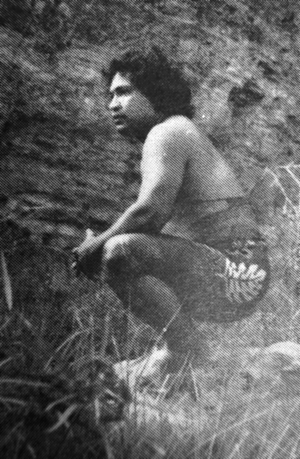
Many Samoan youths seek to get the traditional body tattoo in the traditional way, though the practice still carries a fair amount of risk and will cost the family both material goods and money. In 1988, I wrote this story for my now-defunct Malama Magazine. Not a whole lot has changed regarding traditional Samoan tattooing. Perhaps issuing a shortened version of the story may provide the youth another perspective before taking the plunge.
Sipiki surreptitiously reached for his lavalava (sarong) and gave it slack. “It still hurts,” he said. It was a gray Saturday morning and we were both sitting on bar stools in his dining room talking about his recent trip to Western Samoa. His wife, Florence, a substitute secondary teacher and dance instructor with an occasional charming smile, stood behind the counter gently rebuking him.
“Oh, come on, hon,” Sipiki teased with customary aplomb, and in almost the same breath revealed a knack for averting criticism by asking if I wanted a cup of cocoa.
“No, thanks,” I replied.
“It’s Samoan cocoa,” he insisted.
His wife pushed two mugs of hot cocoa across the counter, mopped a spill off the marble top, then walked into the next room. She looked a tired thirty; the perfect image of the too-young-to-have-a-family mother if there ever was one.
Sipiki shifted on his stool and raised his cup to his lips, casting an uneasy eye toward the door. These days, his wife is not smiling. And he knows why.
A few weeks ago, he and his five-year-old son, Salani, had gone to Western Samoa to visit relatives. A harmless enough vacation. Except on the day they were supposed to return, Florence got a call from a sister-in-law that the trip home had been cancelled. “Sipiki can hardly walk,” the sister-in-law explained. “He just got tattooed. His whole body is swollen.”
At first Florence was concerned. Then concern turned to anger. “I don’t mind him getting tattooed,” she later said. “But his timing was off—way off.”
And indeed, Florence seemed the sort of wife more inclined to give her husband almost anything. But with three children to care for and a $900 rent due the same week, getting tattooed was the last thing she had expected from her husband.
Pragmatic and career-oriented, Florence tends to view family life in terms of job security and money management. And it is hard not to think in these terms on the Mainland. How successfully a migrant family adjusts to urban life depends on a number of things, among which are the family’s cultural beliefs and practices.
In Hawaii, anthropologist Robert Franco noted that Samoan families have “…been able to accommodate large numbers of individuals—newborn children and newly arrived migrants—because of the essential concept within Samoan culture of mutual aid in times of need.”
As is often true of recent migrants, Samoans share characteristics that hinder social, political, and economic mobility in Mainland United States. Further, their rural background “…gives them little preparation in job skills for budgeting and management of money needed in urban areas,” as anthropologist Joan Ablon noted in a paper titled Retention of Cultural Values and Differential Urban Adaptation.
Douthit and Lung similarly noted that most Samoans “…are newcomers and in the lower economic strata. Others are unemployed or employed in menial jobs. Large numbers are on public assistance, and every indication points to increased numbers seeking public assistance in the future.”
If Sipiki is worried, it doesn’t show, even in his self-imposed pain. Today, he is his usual affable and joke-cracking self. One can easily misinterpret his manner for the stereotypical, laid-back islander, taking a tomorrow-will-take-care-of-itself attitude. Not that Sipiki takes his family lightly. Ask him what the most important thing in his life is and almost immediately he’ll reply, “My family.” And indeed, he takes his role as head-of-household and breadwinner seriously. For the past seven years, he has worked as a welder. But because his work depended on weather conditions and individual project requirements, he felt a need to attend night classes to expand his skills, easily putting in twelve hours a day. On weekends, he moonlights as a fire-knife dancer and entertainer, taking spot jobs at local nightclubs or homes of wealthy business people. Two years of struggling with textbooks eventually earned him a position as an ironworker.
So why jeopardize it all on a tattoo?
Perhaps the answer lies in Sipiki’s fascination with and almost cult-like adherence to the Samoan culture especially as exemplified in the matai (chiefly) system and the tatau (tattoo). For him, getting tattooed had always been a dream. “It was just a matter of time. I even told my mother that I would be the first among her sons to get one.”
Wasn’t he the least bit concerned about his job? His family?
“I had no idea it would take this long to heal,” he replied. “I said, four days, I would be back on the plane heading home, ready to work.”
Halfway through the tattooing, however, Sipiki began to seriously wonder if he had not made a tactical error. Getting tattooed requires time; a luxury only a man living on the island can afford. Upon deciding, a young man consults with his family chief, who in turn consults with the family. Long discussions follow in which all the pros and cons are considered.
After the family gives the go-ahead, the chief then prepares for the event by collecting fine mats. A tufuga (tattooer) is sought and after a formal presentation of mats and foods, a day is set aside for the event to take place.
The tattooing itself takes anywhere from three to nine months, allowing for the healing process. Because it extends over much of the body surface, it is “tedious and painful.” The missionary Turner wrote: “After smarting and bleeding for a while under the hands of the tattooers, the patience of the youth is exhausted. They then let him rest and heal for a time, and, before returning to him again, do a little piece on each of the party…In two or three months the whole is completed.”
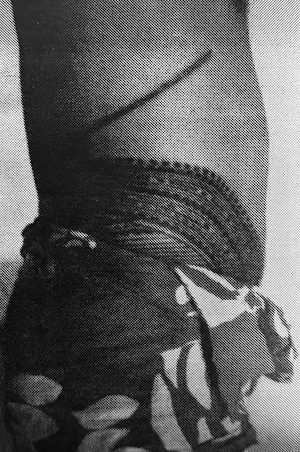
In Sipiki’s case, the entire operation took four days; a feat very few men can boast about. No anesthetic was given. The first day, his lower back and buttocks were tattooed. Two tufuga took turns at the instruments (boar’s tusks) while assistants pulled the flesh taut.
Beginning at nine in the morning, the two men did not let up until eight in the evening. “The end of the first day, I was bleeding like a slaughtered pig,” Sipiki said.
Each day, the operation became more tedious, more draining, more painful. The second day, the tufuga worked the right side and thigh to just above the kneecap.
“Although it was hot, I was shivering,” Sipiki said. “I never felt so cold.”
Third day, the same pattern was repeated in reverse on the left side. And on the last, the kneecaps and navel. By this time, Sipiki had lost quite a bit of blood and the two tufuga were concerned that he might not make it. Sipiki pressed them on. His uncle (the family chief) sat nearby. Throughout the entire session, he had not uttered a word. But the “six-inch blade” he wielded all day said it all. “My uncle tried to dissuade me, saying that it was impossible to get a tattoo in just four days. But I kept insisting. Finally, he said ‘All right. You can have your tattoo. But the minute you say stop, I’ll finish you myself.’ When the tufuga went into my knee, I literally felt him prick my bones. The pain was indescribable.”
But more was to come. “Mid-afternoon the same day, the second tufuga, forehead drenched in sweat, started on my navel. I kept saying, God, it’s almost over. And it almost was—for me. The very first stroke sent electricity through my body. All along, I had fought to keep the pain in. This time, I let it all come out. I screamed.”
But the tufuga, sympathetic though he was, continued to tap away. “The navel is the most important part of the tattoo,” Sipiki explained. “Without it, I wouldn’t have a complete tattoo. That alone took a full two hours.” He paused for a while, zealously tracing the pattern with the tip of his finger. He peeled away dead tissue.
“After it was all over, the tufuga instructed me to take good care of the tattoo. That meant keeping myself in good physical condition and eating the proper foods. So far, I’ve shed three skins. And in less than one week, I’ve lost more than 30 pounds.”
Was it worth it?
A slight hesitation. “As a Samoan, it was,” Sipiki replied. “But as a family man, I don’t know. We’re in a hole. But I guess for every dream, there’s a price.”
Considering everything, perhaps it was a small price to pay.
Had Sipiki terminated the operation, it would have been a disgrace not only for him but for his family as well. And disgraces don’t die easily especially when they stare unfinished from one’s body.
Florence now walked into the kitchen brandishing a hand towel. “Yeah. And write down that because of his tattoo, we have been eating hot dogs for two weeks,” she said. Then she quickly added that the tattoo hadn’t been a total waste. “It made me really believe in the power of prayer. Without God’s help, we wouldn’t have been able to make it.”
Sipiki leaned back on the counter now, managing a smile. With a weekly unemployment check that barely puts food on the table, his role as family provider has truly been tested. “It’s times like this, when you reach in your pocket and find nothing, that you suddenly remember God.”
Sipiki has more than hot dogs to thank God for.
The past few weeks, his brothers and sister have assisted with food and money. Florence’s brother paid for the rent and an older sister bought school clothes for the children. Neither Florence nor Sipiki asked for help. But it is this practice, the spontaneous giving and offering of support, that has made urban living manageable for many Samoan migrants. Though their rural background “…gives them little preparation in job skills for budgeting and management of money needed in urban areas,” very few, if any, experience the usual mishaps, disruption, helplessness, uprooted psyches, or separation of Mainland living.
No doubt, Sipiki and Florence would agree that God had a hand in this as well.
When Elon Musk becomes part of Pacific search-and-rescue
Michael J. Field
The rescue of the Solomon Islands ferry Awka highlights the promise of satellite internet, but the disappearance of Vanuatu’s Matui shows why technology alone is no substitute for proper maritime safe
Elon Musk’s Starlink helped save 73 people stranded aboard a disabled Solomon Islands ferry. Weeks earlier, Vanuatu’s Matui disappeared with about 50 aboard. The contrast exposes a hard truth: satellite internet can transform Pacific search-and-rescue, but it cannot replace seaworthy vessels, proper distress beacons, effective regulation and maritime safety.
 |
Pacific Islanders rightly celebrate their seafaring heritage across Te Moana-nui-a-Kiwa.
Yet the uncomfortable reality is that too many Pacific people are still dying at sea, often in accidents that should be preventable.
This year has been especially grim, exposing persistent failures in vessel safety, regulation and maritime oversight. Two recent incidents, one ending in apparent tragedy and the other in a remarkable rescue, illustrate both the dangers facing Pacific travellers and the emerging role of Elon Musk’s Starlink satellite network in keeping them alive.
(You can follow Michael J. Field in Substack.com).
Drought declared in parts of Tonga as El Niño intensifies
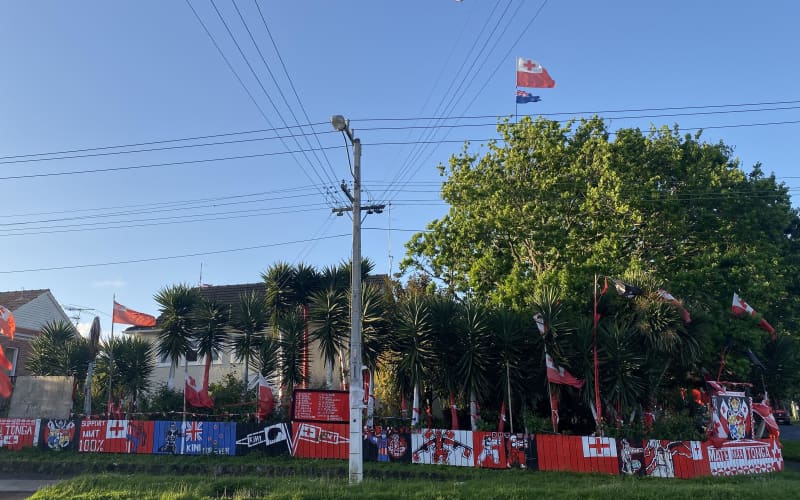
The Tonga Meteorological Service has declared drought across all major islands that make up the kingdom, including Tongatapu, Niuatoputapu, Ha’apai and ‘Eua.
Niuafo’ou, a remote northern island, is still on a drought warning, while Vava’u, in the central division, is on a drought alert.
Tonga Metservice chief climate officer Seluvaia Ilolahia told RNZ Pacific the kingdom is experiencing serious drought conditions.
She said the government is working with stakeholders to ensure communities receive vital information and access the support they need.
“The National Disaster Office, we work very close, and they are also very close to other organisations, for example the work Red Cross and other NGOs especially when it comes to responding to the needs of the community. And the also reach out to the islands when they are distributing water.”
She said there has been some rain in Vava’u but in other areas it’s been below average.
The metservice is also reminding people that the impacts of El Niño may continue even after the event has ended.
Ilolahia said warnings will be in place for the next three months.
“El Niño is still very strong and, like the forecast, it’s probably going to peak around November to December.
“But what we want to stress to the community and people to understand are that the impacts might come later, even after the event, we will still feel it.”
Seluvaia Ilolahia said the public is responding very seriously to the warnings being given out.
WMO
The World Meteorological Organisation (WMO) said sea-surface temperatures in the central and eastern tropical Pacific are forecast to increase to record levels during October-November-December 2026, reflecting the strengthening of the El Niño event which will drive weather patterns and impact economies, ecosystems and communities across the globe.
El Niño is already causing disruption and devastation from droughts and floods in various parts of the world.
The monthly Global Seasonal Climate Update from the WMO said that El Niño will continue to intensify ahead of its forecast peak in December.
It is likely to bring above-average temperatures to much of the globe and shift rainfall patterns, increasing the risk of drought and floods in different regions.